
Certified, Audited and Compliant
Certifications That Matter to Wholesale Buyers
Most manufacturers list certifications and leave buyers to work out what each one means and why their retail chain requires it. Sapana holds seven internationally recognised certifications covering product safety, recycled content, ethical trade and quality management. This page explains what each certification covers, which markets require it and how to get the documentation your compliance team needs.
Why This Matters
Why Certifications Are Not Optional for Wholesale Mat Buyers EU retail chains require OEKO-TEX and SMETA before a supplier can be listed on their approved vendor register at all. UK retailers require BSCI or SMETA as social compliance conditions and Australian chains increasingly require ethical trade documentation. Suppliers who cannot demonstrate compliance through third party certification do not get listed by any major retail chain.
Global Recycled Standard (GRS)
GRS certifies the recycled content in Sapana’s PP products and verifies the entire chain of custody from waste to finished mat. It confirms that recycled PP actually comes from verified recycled sources and audits every facility involved in the supply chain. Required by major EU retail chains for any product marketed with recycled content claims or green procurement obligations.
BSCI, Business Social Compliance Initiative
BSCI assesses manufacturing facilities against the Amfori Code of Conduct covering workers rights, health and safety and the environment. SMETA and BSCI cover similar ground but are operated by different organisations and accepted by different retail chains globally. Sapana holds both which means we satisfy the requirements of retail chains across the full EU buyer landscape without exception.

SMETA, Sedex Members Ethical Trade Audit
SMETA is a third party audit covering labour standards, health and safety, environmental performance and business ethics. The audit report is uploaded to the Sedex platform and accepted by most major retail chains as a substitute for their own factory audit. Required by most major EU, UK and Australian retail chains as a condition of supplier registration and annual requalification.
OEKO-TEX Standard 100
OEKO-TEX certifies that every component of the finished product has been tested free from harmful substances at skin contact levels. Testing covers 100+ substances including heavy metals, formaldehyde, pesticide residues, pH value and colourfastness across the range. Required by virtually all major EU, UK and Australian retail chains for indoor textiles and increasingly for outdoor mats too.

SCAN, Supplier Compliance Audit Network
SCAN aligns with the US Customs Trade Partnership Against Terrorism (CTPAT) programme requirements for supply chain security. The audit covers cargo integrity, access controls, personnel security, procedural controls and cybersecurity for shipment documentation. For US buyers it reduces the risk of shipment delays at customs inspection and satisfies CTPAT compliance requirements for major chains.
GoodWeave
GoodWeave provides independent verification that a product is free from child labour and forced labour throughout the entire supply chain. GoodWeave licensed manufacturers are subject to unannounced inspections and ongoing monitoring beyond the initial certification audit. For buyers supplying retailers who publish anti-slavery statements GoodWeave is the most credible independent evidence available.
Amfori QMI
Amfori QMI covers quality management systems, product safety standards and international trade compliance operated by Amfori. It confirms that documented quality management processes meet international standards as an ongoing operational practice not just at audit. Relevant for buyers supplying pan-European retail chains that use Amfori’s platform for both social compliance and quality management.
Market Requirements
For EU Retail Buyers
OEKO-TEX Standard 100 is required by virtually all major EU retail chains for indoor and outdoor textiles. SMETA or BSCI is required as a social compliance audit depending on the retailer's country of headquarters. GRS is needed for any product with recycled content claims. REACH compliance is mandatory by EU law for all orders.
For UK Retail Buyers
OEKO-TEX Standard 100 and SMETA are the two certifications required by most major UK retail chains as baseline supplier qualification. Modern Slavery Act compliance is additionally required, which the SMETA audit covers directly. GoodWeave is valued by UK retailers who publish ethical sourcing policies and anti-slavery statements to their consumers.
For US Retail Buyers
OEKO-TEX Standard 100 is widely requested by retail buyers across all product categories. SCAN certification reduces customs clearance delays and satisfies CTPAT alignment for major US retail chains. California Proposition 65 compliance documentation is required for all products sold in California covering restricted chemical exposure thresholds.
For Australian Retail Buyers
OEKO-TEX Standard 100 is required by Woolworths Group, Bunnings, and most large-format home and garden retailers. SMETA satisfies the ethical sourcing requirements of virtually all major Australian retail chains. GRS is required for buyers with green procurement obligations or published sustainability commitments within their retail chain trading terms.
Reach Compliance
REACH is EU law governing chemical substances in all products sold within the European market and it is not a voluntary certification. Manufacturers must demonstrate that their products do not contain restricted substances above threshold levels set by the European Chemicals Agency. Sapana Mats was the first Indian mat manufacturer to produce rugs with recycled plastic conforming to REACH standards. Recycled PP presents additional compliance challenges because recycled feedstock can contain contaminants from its original use. Sapana’s programme is designed and tested to comply across all EU bound orders, with full REACH documentation covering the recycled feedstock chain of custody available on request.

Export Quality Standards
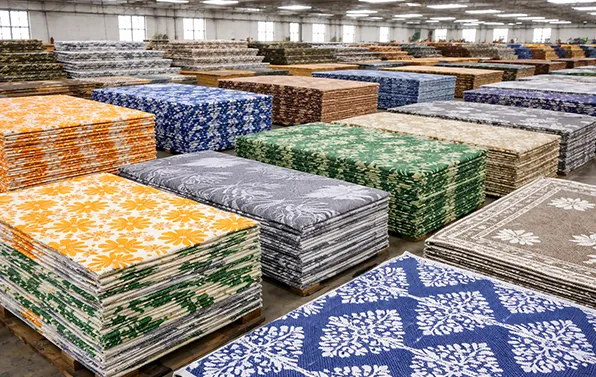
Sapana Mats operates the only in-house testing laboratory among Indian polypropylene mat manufacturers, testing every production batch for GSM accuracy, dimensional accuracy, colourfastness, tensile strength, and UV resistance before goods are packed. This is batch level testing throughout the production run, not a spot check at the start of production. Every shipment includes a commercial invoice, packing list, bill of lading, certificate of origin, and all relevant compliance documentation for your market including OEKO-TEX, GRS, SMETA, BSCI, REACH, and SCAN automatically. Pre-shipment inspection reports and additional market specific documents are available on request at order placement.